
Currently Empty: 0,00 CHF


0 Comments
On 24 February 1957 the Malecón closed to traffic. The seafront that holds Havana and the gulf together — a little over five kilometres of wide corners, low walls, palm trees and no protection worth the name — became, for one afternoon, one of the fastest street circuits ever laid out in a city.
It was the first running of the Cuban Grand Prix. Only two more followed, and in four years the race managed to produce a legendary winner, a kidnapping that reached front pages across half the world, and an abrupt ending. It is the story Cuervo y Sobrinos has chosen to bring back to the wrist with a trilogy of Swiss chronographs dedicated to those three races.

1957: Fangio opens the account
The idea was to draw North American visitors to Cuba, in a city that by the second half of the 1950s was already the most fashionable in the Caribbean: full hotels, orchestras until dawn, the shop windows of Calle Muralla and the salons of San Rafael. A motor race along the sea completed the picture better than any advertising campaign could.
Juan Manuel Fangio won in a Maserati 300S, ahead of Carroll Shelby in a Ferrari 410 S and Alfonso de Portago in a Ferrari 860 Monza — a podium that now reads like an index of the decade. Spectators pressed against the seafront wall a few metres from the cars, drivers approached 250 km/h along the Malecón straight, and nobody at the time found any of it especially unreasonable.
The course ran for roughly three miles through the city streets. High kerbs, deep gutters, a few palm trees: the only separation between the cars and the crowd was the pavement itself, with no straw bales and no sandbags. The seafront straight was the fastest stretch and the most exposed, with balconies looking directly onto the line the cars were taking.
Who was there, and why it mattered to them
The two Malecón editions drew much of the era’s motorsport elite: alongside Fangio, Moss and Shelby came Phil Hill, Wolfgang von Trips, Masten Gregory, Maurice Trintignant, Jean Behra, Jo Bonnier and Harry Schell. It was not a world championship round and carried no points: it was a sports car race, well funded, sociable, and placed in exactly the right month — February, with Europe at a standstill and the Caribbean at its best.
For the drivers it meant a week in Havana in the depths of the European winter; for the city, a few days of international attention. It was a convenient arrangement for both sides while it lasted, and it did not last long.
1958: the race the world remembers
The following year Maserati arrived with its works team and two names on the entry list: Fangio and Stirling Moss. On the eve of the race Fangio was taken from his hotel by armed men linked to the revolutionary movement. He did not race. He was released unharmed shortly after the finish and handed over to the Argentine embassy; in later years he spoke of his captors without bitterness.
The authorities decided the race would go ahead regardless. Moss and Masten Gregory traded the lead until, on the sixth lap, the Ferrari of Cuban driver Armando García Cifuentes lost grip on a patch of oil and went into the crowd lining the road: seven spectators lost their lives and dozens were injured. The red flag ended everything after just six laps.
Victory went to Moss, in a Ferrari 335 S — arguably the strangest of his career. That afternoon entered the collective memory of motorsport as one of the occasions when the line between spectacle and danger, then almost non-existent, showed itself for what it was.
| Discover the Gran Premio de Cuba trilogy among the latest arrivals: three numbered editions, one for each of the Havana races. |
Gran Premio de Cuba 1960
Inspired by the legendary Havana street races of the late 1950s, the Gran Premio de Cuba Trilogy pays tribute to a unique chapter in motorsport history. Each limited-edition chronograph celebrates one of the only three races ever held—1957, 1958, and 1960—through distinctive colors, vintage racing details, and Swiss mechanical craftsmanship.
A contemporary expression of speed, elegance, and Havana’s enduring spirit.
4.800,00 CHF
1959, the year that never happened. 1960, the final act
The 1959 edition was never held. The race returned in 1960, though not to the Malecón: the course was laid out on the perimeter roads of the Camp Columbia military airfield, on the edge of the city. No more sea, no more palms, no more balconies overlooking the track.
Moss won again, this time in a Maserati Tipo 61 “Birdcage” run by the privateer Camoradi team, ahead of Pedro Rodríguez in a Ferrari and Masten Gregory in a Porsche. It was the last. The Cuban Grand Prix closed after only three editions, and Havana stopped being a racing city almost without noticing.
-

Gran Premio de Cuba 1957
4.800,00 CHF -

Gran Premio de Cuba 1958
4.800,00 CHF -

Gran Premio de Cuba 1960
4.800,00 CHF -
Heritage Limited Edition
5.400,00 CHF
Why three races were enough to make a legend
Three editions are not many on which to build a sporting tradition. The Cuban Grand Prix never had time to become a fixture, never entered the world championship calendar and left behind no permanent circuit to visit. It is still discussed, all the same, and recounted more often than races that ran for thirty years.
The reason lies in the density of those four years: a five-time world champion opening the account along the seafront, a kidnapping on the eve of the second edition, a tragedy after six laps, an epilogue on the perimeter of a military airfield. That is the quantity of history a decade usually takes to produce, compressed into three February afternoons.
| YOU MAY ALSO LIKE The Gran Premio de Cuba Trilogy: Three Chronographs for Three Legendary Races Robusto Sans Souci: The Glamour Spirit of 1950s Havana |
Three races, three chronographs
The trilogy by Cuervo y Sobrinos does not treat that story as an allusion: it takes it literally. The colours of the three dials come from the original posters of the three editions.
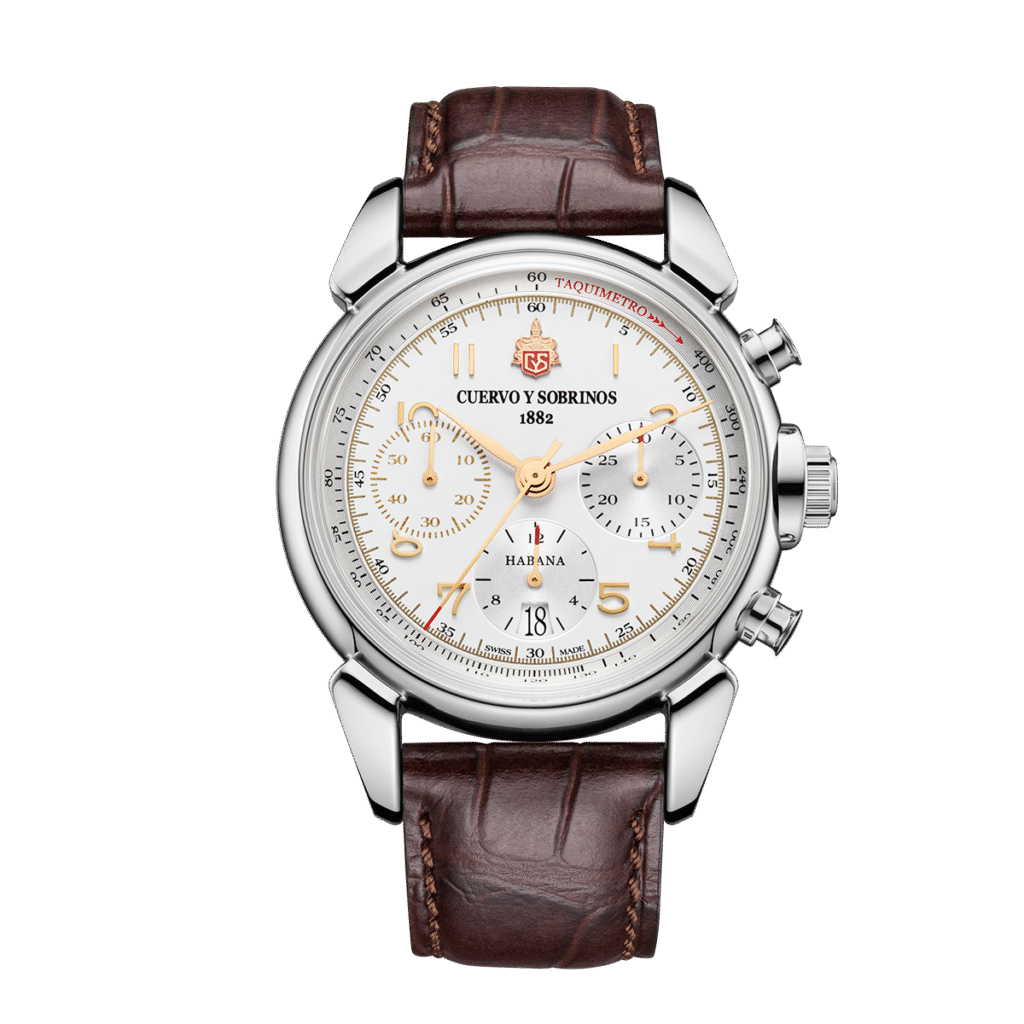
The Gran Premio de Cuba 1957 carries the warm brown and mustard yellow of the inaugural poster, the tones of that first race along the sea. The 1958 is the boldest of the three: racing yellow with green counters, echoing the dashboards and coachwork of period sports cars. The 1960 closes the set in the white and red of the last poster’s geometric artwork — the race nobody yet knew would be the final one.

The edition sizes say something too. They are not round numbers: 162, 174 and 202 pieces, matching the distance in miles covered in each of the three races. It is the kind of decision only noticed by someone who knows the history, which is exactly why it is worth telling.
The choice of a chronograph, incidentally, is not decorative. In the late 1950s a race was timed by hand in the pits, on mechanical instruments started by a thumb at the right moment: accuracy depended as much on the movement as on the reflexes of whoever set it running. It is the one complication that still carries that gesture, and the reason a pusher breaking with the right resistance continues to mean something to the person pressing it, sixty years on.
Underneath, the mechanics are what a racing chronograph should offer: a Valjoux 7750 automatic movement, a 48-hour power reserve, a 41 mm stainless steel case and a see-through sapphire caseback with an oscillating weight shaped like a steering wheel, the year of the race engraved alongside it. The Swiss savoir-faire of the Capolago atelier holds together a Cuban story and a watchmaking tradition with nothing Caribbean about it: precisely the meeting point the Maison has always worked from.
| Browse the full Chronograph collection or find your nearest authorised retailer to see them in person. |
Gran Premio de Cuba 1958
4.800,00 CHF
Inspired by the legendary Havana street races of the late 1950s, the Gran Premio de Cuba Trilogy pays tribute to a unique chapter in motorsport history. Each limited-edition chronograph celebrates one of the only three races ever held—1957, 1958, and 1960—through distinctive colors, vintage racing details, and Swiss mechanical craftsmanship.
A contemporary expression of speed, elegance, and Havana’s enduring spirit.
2 in stock
Why this story belongs to Cuervo y Sobrinos
There is no need to force the connection. In the years when the Malecón closed for racing, the Cuervo y Sobrinos boutique stood a few blocks away, in the same Havana of hotels, orchestras and cigars that the drivers themselves frequented once the flag had fallen. Founded in 1882, the Maison was part of the fabric of that city long before the Maseratis arrived.
It is the same decade that gave both name and character to models such as the Robusto Sans Souci, and the same city that named the Historiador collection after Eusebio Leal Spengler, the Historian of Havana who led the restoration of its old centre. That memory returns in the humidor box in which every timepiece is delivered — a nod to a cigar culture that in Havana was craft and conversation at once.
Telling the story of the Cuban Grand Prix, for the brand, therefore means telling the story of its own neighbourhood in a particular year. Which is the most honest way to handle heritage: claiming nothing that is not there, and not pretending to have arrived later either.
| YOU MAY ALSO LIKE Ernest Hemingway and Cuervo y Sobrinos: An Immortal Bond Sir Winston: 282 Timepieces for a Twentieth-Century Icon |
The Malecón is still there
The seafront has not changed much: the same waves clearing the wall when the wind turns north, the same row of façades bleached by salt. The races, on the other hand, never came back, and none of the three editions had a sequel.
What remains are the posters, a handful of black-and-white photographs, and the accounts of those who stood on the wall that February afternoon. What remains above all are the names, which back then were enough to fill an afternoon on their own: Fangio, Moss, Shelby, de Portago. The last of them would be dead within three months, at the Mille Miglia of May 1957, and that too belongs to the same story.
And now there are three chronographs carrying those colours and those numbers, for anyone who prefers history they can also wear. No rewriting of the past, simply a way of keeping it on the wrist, measured with the precision the Maison has applied to time since 1882.
