
Currently Empty: 0,00 CHF


0 Comments
One hundred and sixty-two, one hundred and seventy-four, two hundred and two. Anyone who collects watches soon learns to be wary of edition sizes: too often the number is chosen because it sounds good, or because it sits comfortably below a threshold. In the Gran Premio de Cuba trilogy the three numbers are neither round nor comfortable. They are the miles covered in each of the three races run in Havana between 1957 and 1960, and that changes the way you look at them.
The story of those races and the colours of the three dials have already been told. This article goes into the detail of what makes the three Swiss chronographs of the trilogy a collector’s object: the logic of the numbering, the caseback almost nobody sees, the calibre that keeps them running, the box they arrive in. For anyone who wants to know what they are buying, before they buy it.

The edition size as a story
A limited edition is, before anything else, a promise: that many pieces and no more. But a number can also say something. The Gran Premio de Cuba 1957 is produced in 162 pieces, the number of miles of the inaugural race along the Malecón. The 1958 stops at 174, the 1960 at 202: the distances of the other two editions, the second along the seafront and the last on the perimeter roads of Camp Columbia.
The result is a trilogy in which rarity is not uniform. The 1957 is the scarcest of the three and the 1960 the most widely available, and the difference comes from history rather than from a sales table. For a collector it is a precious detail: each piece carries an engraved number running from one to the distance of a race, and whoever owns it has, in a sense, one mile of that afternoon.
The Maison has used numbering as a language before: the Sir Winston of the Churchill collection is limited to 282 pieces, and the white-dial Chronograph Heritage is also a limited edition. But in the trilogy the bond between number and meaning is the tightest the brand has ever proposed.
| Explore the Cuervo y Sobrinos limited editions among the latest arrivals and see how many pieces of each edition remain available. |
Limited and numbered: two words that do not mean the same thing
It is worth pausing on the terms, because in catalogue language they are often confused. A limited edition declares a production ceiling. A numbered edition adds something more: each piece carries its own progressive number engraved on it, and that number makes it distinguishable from every other in the same series. The Gran Premio de Cuba trilogy is both, and the numbering is the part a collector cares about most.
The engraved number is what ties the individual watch to its papers, its box and, over time, its history of ownership. In a market where the value of a piece depends partly on the completeness of what comes with it, a numbered edition in which number, warranty and humidor all match is a far more legible object than one that is merely limited. That is another reason why the trilogy’s odd, unbusinesslike edition sizes turn out to be so convincing.
The caseback: a steering wheel under sapphire
Turn the watch over. The screwed caseback is in sapphire crystal and reveals the movement, as on many modern automatics. On these three, however, the oscillating weight — the rotor that winds the mainspring with every movement of the wrist — has been shaped like a steering wheel, its spokes and rim recalling the wood-and-aluminium wheels of 1950s sports cars. At the centre sits the CyS emblem, applied in 2N gold colour with red accents.
Around it, the year of the race is engraved on the caseback: 1957, 1958 or 1960. It is the detail that tells the three pieces apart for good even when the dial is out of sight, and it is the first place a collector looks to understand whether a watch was designed or merely produced. This one was designed. Each time the watch is taken off and set down on a bedside table, the wheel turns for a few seconds and then stops, and the scene looks rather like a car being switched off at the end of a lap.
Gran Premio de Cuba 1957
Inspired by the legendary Havana street races of the late 1950s, the Gran Premio de Cuba Trilogy pays tribute to a unique chapter in motorsport history. Each limited-edition chronograph celebrates one of the only three races ever held—1957, 1958, and 1960—through distinctive colors, vintage racing details, and Swiss mechanical craftsmanship.
A contemporary expression of speed, elegance, and Havana’s enduring spirit.
4.800,00 CHF
Valjoux 7750: the chronograph that set the standard
The calibre driving the trilogy is the Valjoux 7750, self-winding, with a 48-hour power reserve, 30 mm in diameter and 7.9 mm high. For anyone unfamiliar with it: this is the most widely used Swiss automatic chronograph movement in history, designed in the early 1970s and still the reference for anyone who wants a chronograph that will run without surprises for decades.
Its cam-operated architecture, simpler than a column wheel, gives it proverbial robustness and makes servicing accessible to any competent watchmaker, years from now and anywhere in the world. For a collector that argument weighs as much as beauty: a watch meant to be kept for a long time needs a heart that can be cared for. The 7750 also has a recognisable tactile signature — a start pusher that breaks with firm resistance — and anyone who has tried it once will find it again with their eyes closed.
On the dial the calibre lays itself out in the traditional way: small seconds at nine o’clock, minute counter at twelve, hour counter at six with the date in the same window. The central chronograph hand has a red tip, and the counter hands are arrow-shaped, also in red: reading elapsed times stays immediate even on a dial as rich as that of the 1958, racing yellow with green counters.
| YOU MAY ALSO LIKE The Gran Premio de Cuba Trilogy: Three Chronographs for Three Legendary Races Heritage Chronograph: A Journey Through Time and Style |
-

Gran Premio de Cuba 1957
4.800,00 CHF -

Gran Premio de Cuba 1958
4.800,00 CHF -

Gran Premio de Cuba 1960
4.800,00 CHF -
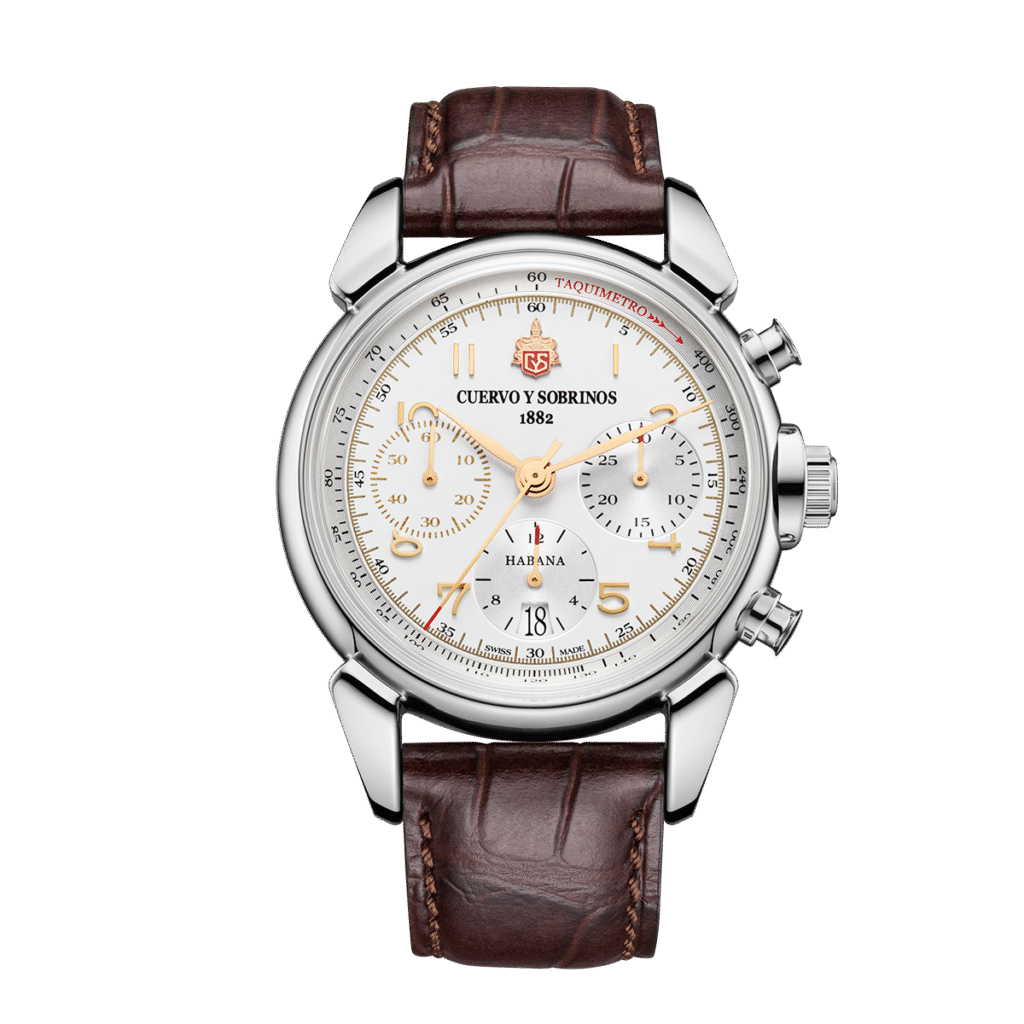
Heritage Limited Edition
5.400,00 CHF
The case, and the details you notice by touch
The stainless steel case measures 41 mm across and 15.25 mm high — the thickness of a true automatic chronograph, which you feel on the wrist and which the strap keeps in check. The pushers are rectangular rather than round, and that choice changes the gesture: you press the pad of your finger against a flat surface, as on the dashboard chronographs of an earlier age. The double-curved sapphire crystal with anti-reflective coating and water resistance to 5 ATM complete the picture.
The strap is matte black calf leather, perforated in driving style, with stitching in the colour of the counters — mustard on the 1957, green on the 1958 — and a matching lining. The stainless steel folding buckle carries the engraved CyS emblem. The hour, minute and small seconds hands are leaf-shaped: a profile the brand uses on many of its classic models and which here, inside a sporting context, keeps the thread running back to the tradition of the Maison born in Havana in 1882.
One last detail a collector will appreciate: the three editions share case, calibre, hands, buckle and box, and differ only in dial, stitching and caseback. Comparing the three is therefore a comparison between equals, decided by colour and by number alone. In a series built this way there is no first-class version and no fallback, and part of the trilogy’s value lies in precisely that even-handedness.
| Browse the brand’s other exclusive editions or find your nearest authorised retailer to see the trilogy in person. |
The humidor, the warranty and a collector’s good habits
Every Gran Premio de Cuba arrives in the original PE100 humidor in cedar, with a hygrometer and no adhesives, about the size of a small cigar box. It is the box that accompanies the most important models in the catalogue, and with a limited edition it takes on an extra role: together with the engraved number, it is the proof of where the watch came from. It is worth keeping with the piece, alongside the papers.

The five-year warranty is activated online at the time of purchase and applies to every timepiece by the brand. These are gestures an experienced collector makes without thinking, and which are worth mentioning to anyone buying their first limited edition: ten years from now, a watch with its humidor, its papers and a registered warranty tells a different story from one without.
A final word on the three versions together. The trilogy is designed to be collected, but each chronograph has enough character of its own to stand alone. Those after the rarest piece will choose the 1957; those who want the boldest, the 1958; those who prefer a dial that goes with everything, the 1960, white with red counters. Those who want all three already know what to do.
| YOU MAY ALSO LIKE From Racing Spirit to Everyday Elegance: How to Wear the New Chronographs Sir Winston: 282 Timepieces for a Twentieth-Century Icon |
Inspired by the legendary Havana street races of the late 1950s, the Gran Premio de Cuba Trilogy pays tribute to a unique chapter in motorsport history. Each limited-edition chronograph celebrates one of the only three races ever held—1957, 1958, and 1960—through distinctive colors, vintage racing details, and Swiss mechanical craftsmanship.
A contemporary expression of speed, elegance, and Havana’s enduring spirit.
Gran Premio de Cuba 1960
4.800,00 CHF
2 in stock
A mile on the wrist
The limited editions that age well all have one thing in common: the reason for the number still makes sense later, when the launch is far behind and only the watch and its owner remain. One hundred and sixty-two, one hundred and seventy-four, two hundred and two are numbers explained in a sentence and remembered for good, which is exactly what one asks of a collector’s piece.
The rest is down to the Swiss savoir-faire of Capolago: a calibre that will last, a case built with care, a caseback that rewards anyone who takes the time to look. For a Maison that has been measuring time since 1882, a Havana mile is a fine unit of measurement.
